An Overview of the Methods and Purposes of Creating a Storyboard
When writing your book, your number one priority should be creating a well-structured story. Even in nonfiction memoirs, autobiographies, or devotionals, your book should be plotted out with care and diligence. To do this, create a storyboard throughout your writing process to guide you through it.
Effective storyboards can come in all shapes and sizes, customized to your specific project. Whether creating a storyboard before you begin writing or after your first draft, you should fully embrace the process.
Storyboard Overview
A storyboard is exactly what it sounds like: a board with your story on it. This process is not limited to book writing; it is often used across the entertainment industry. This practice allows you to visualize your story from top to bottom. Often, a storyboard is created by hand and on physical paper. Conversely, you might be able to do it on your computer. The general principles are the same either way.
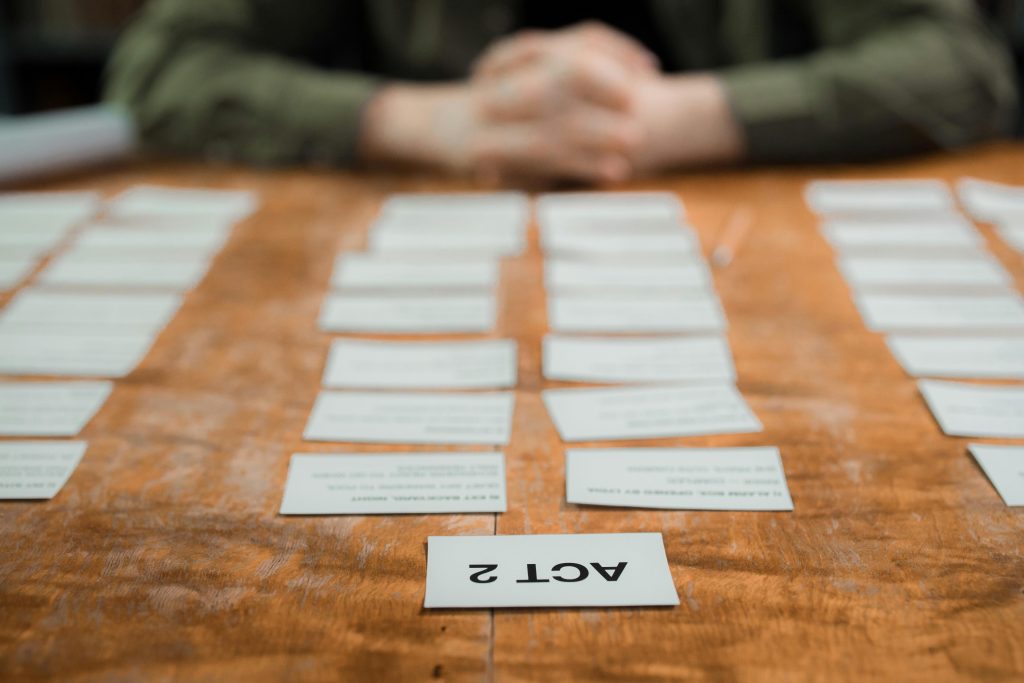
The most important part of a storyboard is separating each individual component. If crafting it by hand, this likely means having a stockpile of index cards or Post-it notes handy. You would then write the individual elements on the cards. These pieces of paper are then arranged to project the flow of your book from start to finish. Once this map is created, you will see the important elements of your story in front of you. You can then reorganize, add to, or take away from it as needed.
Storyboarding is most useful for organizing the racing thoughts in one’s head. You might have a general direction for your book, but putting it on paper will help structure it for you. You will be able to clear the thoughts from your mind and build the story from there.
Plot, Characters, and Drawings
As mentioned, your index card or sticky notes contain the elements of your book. But what are those elements? Three of the most common elements to include are plot beats, characters, and illustrations to guide your visualization. Your storyboard can feature whatever elements you see fit, but here are some common ones.
Plot
Almost every storyboard is going to include significant parts of your book’s plot. This is the crux of a storyboard at its most basic level. You want to see how your story moves from beginning to end, with all the conflict in between. You cannot truly gauge the flow of your story until you see it laid out in front of you.
Once you can visualize your story, you can adjust it as needed. This can take the form of rearranging elements, filling in gaps, or removing extraneous details. You can also see where conflict is needed to add stakes to your story. Your vision guides the entire process.
Characters
Strongly written characters are the backbone of fiction storytelling. Without engaging characters, readers can be left in the dust. When creating a storyboard, include cards for each of your main characters. On them, you should detail as much relevant information about the character as possible: their motivations, background, relevant character arcs, relationships to other characters, etc.
Seeing your characters stripped down to their basic parts can guide you in developing them further. From there, you can see which need more characterization to feel like real people. You can also see if you have too many characters crowding the story, or conversely, too few. The ultimate goal is to create a balanced story filled with realistic characters.
Drawings
Another common element of storyboarding are illustrations. This is obvious for books that will actually include pictures, but it can be used otherwise as well. For picture books, even if you have a separate illustrator, your pictures can direct the entire process. Your words have to match the illustrations.
Having a visual representation of action or scenes can guide your writing in unexpected ways. You cannot control how readers will visualize your story, but you can use your images to influence your writing. You want your audience to see the story as you do.
Nonfiction Storyboarding
Storyboarding for nonfiction books follows a similar logic as for fiction books. It is all about structuring the flow of your book and any important elements in it. Instead of characters, you can include prominent figures you want to quote or reference. You can also include prayers or quotes from Scripture that are spiritual influences in a given segment.
For devotionals and other spiritual guides, you can use a storyboard to create a cohesive vision. This can allow your entries and sections flow into one another naturally. You never want your reader to feel confused by the direction your book is taking.
Three-Act Structure
Most, but notably not all, stories follow a three-act structure. This is not limited to books; movies almost always contain three acts, even if you don’t notice. Simply, these are known as the beginning, middle, and end. Each “act” has a larger purpose in the story. But, the text is not necessarily divided into sections.
Act One: Beginning
Opening your book with a compelling introduction sets the scene for the rest of your book. Usually about a quarter of your book could be considered the first act. In this section, you will introduce your main characters and their motivations, set up the plot, and set the action in motion.
Act Two: Middle and Climax
The middle of your story will take up the bulk of your pages and contain more action. This is where your characters go on their journey, even if not a literal one. It can be an emotional journey, so long as they experience events that allow them to grow.
This will all build to the climax of your entire story, which usually comes towards the end of act two. If you think of an action movie, the climax is the big battle at the end. Of course, other genres have different climaxes, but it should be something the entire story is building towards. This is the largest segment of your story and can be more than half of the overall length.
Act Three: Ending
A strong ending sticks with viewers. This is your final impression to leave the audience with, so make it a good one. You are the only one who knows how your story should end, but make sure it is a satisfying conclusion. You do not want the third act of your book to be too long — the bulk of the action is over. But, you can still have an open ending that leaves room for more stories in your book’s universe.
Post-Writing Storyboarding
You know your writing style better than anyone else. Some authors with a looser writing style find storyboarding more helpful after completing a draft of their book. This serves a different purpose than doing so before you begin writing.
Where earlier storyboarding guides the writing process, later storyboarding helps with revisions and editing. The process and methods of creating a storyboard after finishing a draft are the same as outlined above. You will still physically map out the elements of your book to visualize it. Once you do this based on your writing, you will be able to see areas of improvement. Maybe you notice a plot hole. Maybe you notice an underdeveloped character. From there, you can make adjustments to incorporate into your text while editing.
Individualize Your Storyboard
No matter how and when you use it, creating a storyboard can help make your book more cohesive. There are no hard rules to follow, and you guide your storyboarding as you see fit. There is no “right” kind of storyboarding, just make sure it helps you on your writing journey.